
• Attention Forex Brokers, FX Companies & Hedge Funds.

    forum.forex is available for Acquisition (quick sale)

    Submit your Offer

Daily Market Analysis By FXOpen

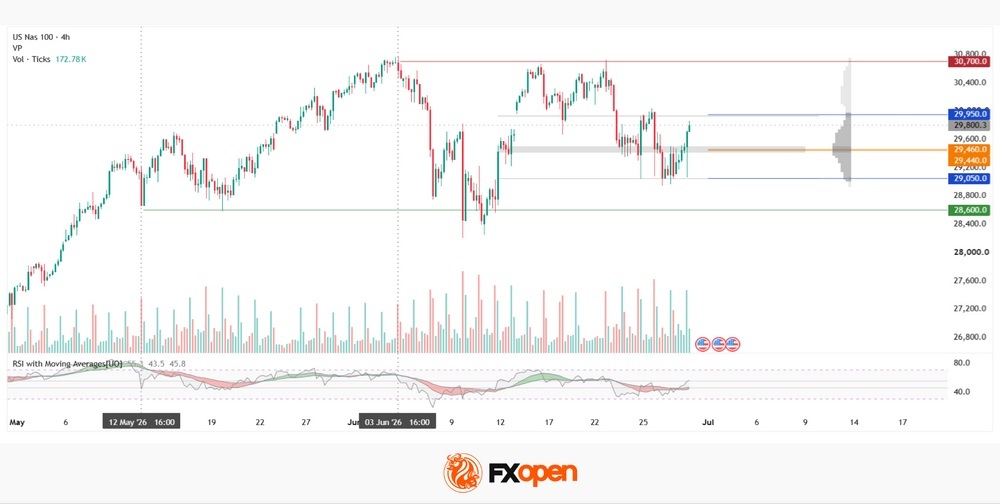
Nasdaq-100: Price Concentrates Within the Market Profile Zone

eFhZy4qW_o.png


Last week was one of the worst for US technology stocks since the beginning of 2026, with the index losing around 4.6% under the influence of two opposing factors. Firstly, the market continued to reassess the pace of returns on AI infrastructure investment — concerns that spending is outpacing actual returns triggered a sell-off in semiconductor stocks, with the Philadelphia Semiconductor Index falling nearly 8% over the week. Secondly, the US-Iran conflict surrounding the Strait of Hormuz escalated over the weekend: Tehran claimed responsibility for attacks on commercial vessels, while the US responded with air strikes. By Monday morning, tensions had eased somewhat as both sides announced a temporary halt to hostilities and agreed to hold talks in Doha on Tuesday. Against this backdrop, Nasdaq-100 futures gained around 1.1%.
n4DEU5ho_o.jpg


TO VIEW THE FULL ANALYSIS, VISIT FXOPEN BLOG

Disclaimer: This article represents the opinion of the Companies operating under the FXOpen brand only (excluding FXOpen EU). It is not to be construed as an offer, solicitation, or recommendation with respect to products and services provided by the Companies operating under the FXOpen brand, nor is it to be considered financial advice.
 
EUR/GBP: Bank of England Holds Rates as ECB Raised Them a Week Earlier
s3XC7dFQ_o.png


Against the backdrop of a weak UK economy and inflation remaining above target, the Bank of England paused in June, leaving the base rate unchanged at 3.75% for the fourth consecutive meeting despite internal disagreements among committee members over the need for a rate increase. The contrast with the European Central Bank's actions was striking: on 11 June, the ECB opted to raise interest rates in response to a surge in eurozone inflation driven by higher energy prices amid the conflict in the Middle East. As a result, the monetary policy paths of London and Frankfurt temporarily diverged, with market attention now shifting to the Bank of England's next meeting on 30 July.

bRGlv7KW_o.jpg


TO VIEW THE FULL ANALYSIS, VISIT FXOPEN BLOG

Disclaimer: This article represents the opinion of the Companies operating under the FXOpen brand only (excluding FXOpen EU). It is not to be construed as an offer, solicitation, or recommendation with respect to products and services provided by the Companies operating under the FXOpen brand, nor is it to be considered financial advice.
 
USD/JPY Tests Multi-Year Highs, While USD/CAD Holds Near Yearly Peaks
LaxQKPbR_o.png


After a strong rally in the US dollar at the end of last week, the currency has moved into a consolidation phase against major counterparts. Investors remain cautious ahead of the release of the ADP employment report for the US private sector, which is expected to serve as a key indicator before Friday’s official Nonfarm Payrolls data. Additional influence on the dollar’s dynamics today may come from the manufacturing PMI and ISM indices, as well as a speech by Federal Reserve Board member Christopher Waller.

Market participants continue to assess the outlook for future Federal Reserve policy. Despite no new rate decisions, Fed officials maintain a hawkish tone, stressing the need to keep interest rates elevated until there are clear and sustained signs of inflation slowing. As a result, demand for the dollar remains strong; however, ahead of key data releases, investors are partially taking profits on long USD positions, contributing to a consolidation phase in the market.

inIJjjcJ_o.jpg


TO VIEW THE FULL ANALYSIS, VISIT FXOPEN BLOG

Disclaimer: This article represents the opinion of the Companies operating under the FXOpen brand only (excluding FXOpen EU). It is not to be construed as an offer, solicitation, or recommendation with respect to products and services provided by the Companies operating under the FXOpen brand, nor is it to be considered financial advice.
 
EUR/CHF: Which Central Bank Is Backing Its Currency Harder?
yal1lFaZ_o.png


The EUR/CHF pair is trading within a clear divergence between the two central banks. The ECB raised rates by 25 basis points on 11 June, lifting the deposit rate to 2.40% — its first hike since 2023 — after eurozone inflation climbed to 3.2% in May on the back of the Middle East-driven energy shock. More recent signals suggest easing pressure, though, as falling oil prices following the peace agreement have reduced expectations of a further hike in July.

On the Swiss side, the SNB left rates unchanged at 0.00% on 18 June, while signalling greater readiness to intervene in the currency market to contain excessive franc strength. Despite the ECB's rate advantage, the franc remains structurally firm below parity, underpinned by its so-called safe-haven status and the still-fragile geopolitical backdrop. A renewed bout of risk-off sentiment could see the franc regain ground even against a higher-yielding euro.

eu4jrzzj_o.jpg


TO VIEW THE FULL ANALYSIS, VISIT FXOPEN BLOG

Disclaimer: This article represents the opinion of the Companies operating under the FXOpen brand only (excluding FXOpen EU). It is not to be construed as an offer, solicitation, or recommendation with respect to products and services provided by the Companies operating under the FXOpen brand, nor is it to be considered financial advice.
 
FTSE 100: Attempting a Breakout from the Triangle
1gHzmG3h_o.png


On 30 June, Prime Minister Keir Starmer unveiled the Defence Investment Plan, which includes a £15 billion increase in defence spending as part of a nearly £300 billion four-year budget. The market reacted quickly: on 1 July, shares of Babcock, BAE Systems and Rolls-Royce gained between 1.1% and 5.2%, providing support for the FTSE 100 during the session. Offsetting this strength, healthcare and energy stocks came under pressure, with AstraZeneca and GSK falling 1.7% and 2.5%, while Shell and BP lost more than 2% as oil prices declined. As a result, the index closed the day 0.2% lower. Over a longer-term horizon, investors remain focused on the Bank of England's meeting on 30 July. The central bank has kept the base rate at 3.75%, while inflation risks remain elevated amid energy price dynamics and geopolitical tensions in the Middle East.

5HvHR3NW_o.jpg


TO VIEW THE FULL ANALYSIS, VISIT FXOPEN BLOG

Disclaimer: This article represents the opinion of the Companies operating under the FXOpen brand only (excluding FXOpen EU). It is not to be construed as an offer, solicitation, or recommendation with respect to products and services provided by the Companies operating under the FXOpen brand, nor is it to be considered financial advice.
 
The Dollar Awaits the Week’s Key Report: AUD/USD and NZD/USD at Crucial Technical Levels
0J9Sf9S2_o.png


Following mixed performance by the US dollar earlier this week, investors are now fully focused on the June Nonfarm Payrolls report, which will be released on Thursday rather than Friday. The schedule has been brought forward as US financial markets will be closed on Friday to mark the 250th anniversary of the signing of the Declaration of Independence. Today's report is expected to shape expectations for the Federal Reserve's monetary policy and set the direction for the US dollar through the remainder of the week.

Market participants will closely watch the unemployment rate, average hourly earnings and initial jobless claims, all of which will be released alongside the headline payrolls data. Following weaker-than-expected ADP employment figures, investors will be looking for confirmation that the US labour market remains resilient. Strong data could reinforce expectations that the Fed will maintain its hawkish stance, supporting the US dollar, while weaker figures may trigger profit-taking on long USD positions.

bbE1ULds_o.jpg


TO VIEW THE FULL ANALYSIS, VISIT FXOPEN BLOG

Disclaimer: This article represents the opinion of the Companies operating under the FXOpen brand only (excluding FXOpen EU). It is not to be construed as an offer, solicitation, or recommendation with respect to products and services provided by the Companies operating under the FXOpen brand, nor is it to be considered financial advice.
 
Oil Prices Are Back at Pre-Conflict Levels. Analysts Are Divided
EN-0207.png


At the start of May, oil markets were still pricing in elevated geopolitical risk and expectations of sustained supply disruption.

But easing tensions between Washington and Tehran, along with improving supply expectations, have rapidly shifted sentiment back toward fundamentals.

Brent crude has fallen back to around $71–74 per barrel
Prices are now close to pre-conflict levels after a drop of more than 35% since early May
The market is reassessing whether the geopolitical risk premium has been fully removed

The debate is now split between two clear narratives.

Bearish case: supply is recovering and demand remains uneven
Bullish case: geopolitical risks in the Strait of Hormuz are still not fully priced in

The key question for markets is whether oil has already priced in good news — or whether volatility is simply paused, not gone.

Gain insights to strengthen your trading knowledge.

TO VIEW THE FULL ANALYSIS, VISIT FXOPEN BLOG

Disclaimer: This article represents the opinion of the Companies operating under the FXOpen brand only (excluding FXOpen EU). It is not to be construed as an offer, solicitation, or recommendation with respect to products and services provided by the Companies operating under the FXOpen brand, nor is it to be considered financial advice.
 
S&P 500: Index Narrows Its Range as the Labour Market Cools
spx.jpg


The broad US market index, the S&P 500, has entered July against a backdrop of mixed signals from the labour market. The Bureau of Labor Statistics report released on 2 July showed that just 57,000 jobs were added in June, well below market expectations, while the unemployment rate stood at 4.2%. Following the release, markets scaled back expectations of a Federal Reserve rate hike in September, although the possibility of an October increase remains. At the same time, the current 10% global tariff is due to expire at the end of July, and markets are gradually pricing in uncertainty surrounding future trade policy decisions.

spx.png


TO VIEW THE FULL ANALYSIS, VISIT FXOPEN BLOG

Disclaimer: This article represents the opinion of the Companies operating under the FXOpen brand only (excluding FXOpen EU). It is not to be construed as an offer, solicitation, or recommendation with respect to products and services provided by the Companies operating under the FXOpen brand, nor is it to be considered financial advice.
 
NZD/CHF Analysis: Which Currency Breaks the Consolidation First?
nzzdusd.png


NZD/CHF remains locked in a tight range as traders await the next monetary policy catalyst.

The Reserve Bank of New Zealand heads into Wednesday's meeting on shaky ground. After May's 3-3 split was resolved by a casting vote, the committee still lifted its rate path sharply, eyeing a 3.28% terminal rate by 2029. But the oil slide following the US-Iran truce has cut hike odds from over 80% to around 66-70%, splitting major banks between a hold and a further move.

Meanwhile, the Swiss National Bank holds firm at 0% for a fourth straight meeting. Switzerland's challenge mirrors New Zealand's in reverse: subdued inflation rather than overheating, leaving little room—or need—for tightening. The franc's strength stems more from so-called safe-haven flows than rate differentials.

The result: NZDCHF caught between short-term RBNZ uncertainty and near-static Swiss policy, with direction hinging on Wednesday's decision.

nzzdusd.jpg


TO VIEW THE FULL ANALYSIS, VISIT FXOPEN BLOG

Disclaimer: This article represents the opinion of the Companies operating under the FXOpen brand only (excluding FXOpen EU). It is not to be construed as an offer, solicitation, or recommendation with respect to products and services provided by the Companies operating under the FXOpen brand, nor is it to be considered financial advice.
 
Back
Top Bottom