
• Attention Forex Brokers, FX Companies & Hedge Funds.

    forum.forex is available for Acquisition (quick sale)

    Submit your Offer

Daily Market Analysis By FXOpen

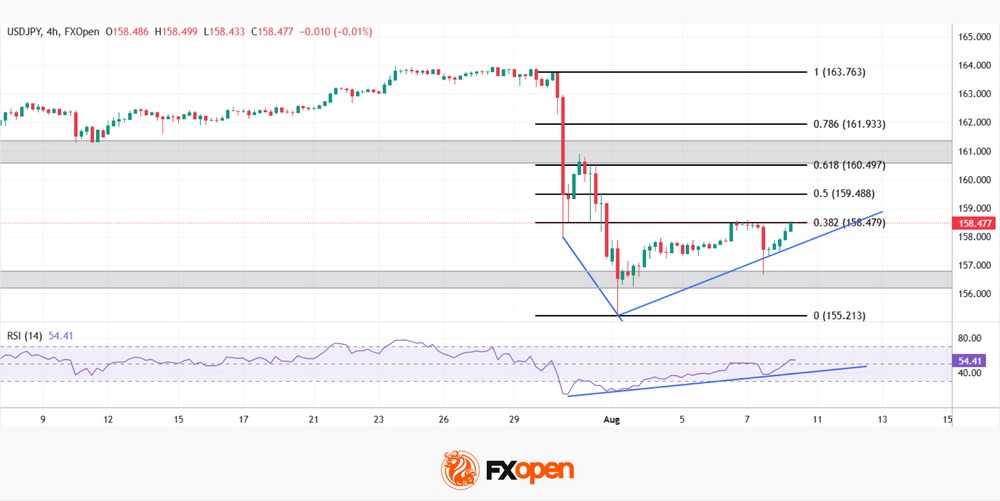
USD/JPY: Was Intervention Enough to Change the Trend?

yen.png


USD/JPY finds itself at the center of one of the most dramatic currency stories this summer. Having weakened to a four-decade low near ¥164, the yen was pulled back sharply after Japan and the US carried out a coordinated intervention, with Tokyo reportedly spending around $34 billion in a single session to defend its currency. The move briefly pushed the pair toward ¥155, though the yen has since given back some of those gains, trading back near ¥158 as doubts persist over how long intervention alone can hold.

The underlying driver remains the wide gap between US and Japanese interest rates, made worse by rebounding oil prices following renewed tensions in the Strait of Hormuz. Markets are now watching for a possible BoJ hike in September, encouraged by six straight months of rising real wages, while the Fed's own July dissents—three policymakers pushed for a hike over a hold—keep US rates firmly in the driver's seat too.

With both central banks now genuinely in play, USD/JPY's next move looks set to hinge on which side moves first: Tokyo's rate decision, or Washington's next data-driven signal.
yen.jpg


TO VIEW THE FULL ANALYSIS, VISIT FXOPEN BLOG

Disclaimer: This article represents the opinion of the Companies operating under the FXOpen brand only (excluding FXOpen EU). It is not to be construed as an offer, solicitation, or recommendation with respect to products and services provided by the Companies operating under the FXOpen brand, nor is it to be considered financial advice.
 
EUR/AUD: Two Central Banks on Hold, One Triangle About to Break
1-(1).png


Overnight, the RBA held its cash rate steady at 4.35%, as widely expected after June's inflation data came in softer than forecast at 3.8% headline. Yet the accompanying statement struck a notably cautious tone, warning that trimmed mean inflation remains elevated and largely unchanged from the March quarter, with oil and related commodities still trading above pre-conflict levels due to the ongoing Middle East crisis. With 55% of economists still expecting at least one further hike in 2026, the door to additional tightening remains firmly open.

The euro, meanwhile, holds a cautiously bullish tone after climbing to a seven-week high near $1.155 against the dollar. Eurozone Q2 growth of 0.4% offered support, though weaker retail activity and mixed inflation signals keep the ECB's own path uncertain, with policymakers maintaining a deliberately cautious stance ahead of their September 15-16 meeting and giving no firm commitment to further hikes.

The result: two central banks in genuine holding patterns, each leaving the door open to more tightening while waiting for clearer data to justify the next move.

1-(2).jpg


TO VIEW THE FULL ANALYSIS, VISIT FXOPEN BLOG

Disclaimer: This article represents the opinion of the Companies operating under the FXOpen brand only (excluding FXOpen EU). It is not to be construed as an offer, solicitation, or recommendation with respect to products and services provided by the Companies operating under the FXOpen brand, nor is it to be considered financial advice.
 
EUR/USD and GBP/USD Await a Fresh Impulse from Inflation Data
eurgbp.jpg


The euro and pound are holding their ground against the US dollar, although the momentum in European currencies has become more subdued following their previous gains. Market participants are reluctant to establish new positions ahead of the release of the July US inflation report, which could alter expectations for the Federal Reserve’s future policy. Recent labour market data is also encouraging caution: a weak ADP report and a decline in the ISM employment component have added to signs of a gradual cooling in the US labour market.

Today, the main focus will be on the US Consumer Price Index (CPI). According to forecasts, annual inflation may slow to 3.4% from 3.5%, while monthly prices are expected to rise by 0.1% after falling 0.4% a month earlier. Core CPI is forecast at 2.5% year-on-year and 0.2% month-on-month. Weaker-than-expected figures could strengthen expectations of monetary policy easing by the Fed and put additional pressure on the dollar. If inflation comes in above forecasts or proves more persistent, the US currency could receive fresh support. Final inflation figures for Germany and Italy will also be released in Europe, although their impact is likely to remain limited in the absence of significant deviations from preliminary estimates. Therefore, US inflation data is likely to be the main driver for EUR/USD and GBP/USD during today's session.

eurgbp.png


TO VIEW THE FULL ANALYSIS, VISIT FXOPEN BLOG

Disclaimer: This article represents the opinion of the Companies operating under the FXOpen brand only (excluding FXOpen EU). It is not to be construed as an offer, solicitation, or recommendation with respect to products and services provided by the Companies operating under the FXOpen brand, nor is it to be considered financial advice.
 
DAX 40: Record Highs, Real Fundamentals, One Channel Left to Test
dax.jpg


Germany's benchmark index just made history, breaking above 26,500 for the first time ever, extending a rally that has already delivered close to 10% over the past twelve months. The move came on fresh optimism around a potential resolution to the Iran conflict, though that optimism proved short-lived: President Trump's latest demands, that Tehran compensate for lives lost in recent attacks, have since added friction to already fragile diplomatic efforts around reopening the Strait of Hormuz, and the index has pulled back modestly from its peak.

Beneath the geopolitical noise, the underlying story remains genuinely constructive. Stronger-than-expected industrial production and export data have reinforced confidence in German manufacturing, while a wave of solid corporate earnings, alongside notable strength from SAP and Infineon, has kept sentiment firmly bullish. Roughly a third of this year's growth still owes to calendar effects and government stimulus in defence and infrastructure, a detail worth remembering, but private-sector momentum finally looks like it's stabilizing rather than collapsing.

The result: a record-breaking index now testing whether Middle East headlines can derail a rally built on genuinely improving fundamentals.

dax.png


TO VIEW THE FULL ANALYSIS, VISIT FXOPEN BLOG

Disclaimer: This article represents the opinion of the Companies operating under the FXOpen brand only (excluding FXOpen EU). It is not to be construed as an offer, solicitation, or recommendation with respect to products and services provided by the Companies operating under the FXOpen brand, nor is it to be considered financial advice.
 
Natural Gas Analysis: Attempted Wedge Breakout Amid Lower EIA Forecast
xngusd.png


On 11 August, the US Energy Information Administration (EIA) lowered its forecast for the average natural gas price in the third quarter to $2.87 per million BTU — 50 cents below its previous estimate. The main reason is increased domestic production and inventories, which could create the largest stockpile in a decade ahead of the start of the heating season. Planned maintenance at the Freeport LNG export terminal may have added further pressure to the balance by reducing demand for gas used in liquefaction. Meanwhile, global LNG trade had already faced shipping disruptions in the Strait of Hormuz in July, highlighting the market’s continued sensitivity to geopolitical risks.

xngusd.jpg


TO VIEW THE FULL ANALYSIS, VISIT FXOPEN BLOG

Disclaimer: This article represents the opinion of the Companies operating under the FXOpen brand only (excluding FXOpen EU). It is not to be construed as an offer, solicitation, or recommendation with respect to products and services provided by the Companies operating under the FXOpen brand, nor is it to be considered financial advice.
 
The US Dollar Strengthens After Inflation Data: AUD/USD and USD/CAD at Key Levels
usd.jpg


The US dollar strengthened against commodity currencies following the release of July US inflation data. The annual Consumer Price Index (CPI) came in at 3.4%, exactly in line with forecasts and down from the previous 3.5%, while prices rose by 0.1% month-on-month. Core inflation also matched expectations, at 0.2% month-on-month and 2.5% year-on-year. Despite the continued easing in price pressures, the report did not deliver any additional disinflationary surprise to the market. Inflation is gradually moving towards the Fed’s target, but the current pace of decline is still insufficient to significantly strengthen expectations of an imminent easing of monetary policy. Against this backdrop, the US dollar managed to recover some of its earlier losses.

usd.png


TO VIEW THE FULL ANALYSIS, VISIT FXOPEN BLOG

Disclaimer: This article represents the opinion of the Companies operating under the FXOpen brand only (excluding FXOpen EU). It is not to be construed as an offer, solicitation, or recommendation with respect to products and services provided by the Companies operating under the FXOpen brand, nor is it to be considered financial advice.
 
EUR/GBP Analysis: Triangle Breakout Attempt Following an Uptrend
eurgbp.jpg


On 13 August, the UK Office for National Statistics (ONS) reported that GDP growth slowed to 0.4% quarter-on-quarter in the second quarter, down from 0.6% in the first quarter. The figure was in line with expectations, and the market reaction was relatively muted.

The interest-rate backdrop has also remained broadly unchanged for several weeks. On 30 July, the Bank of England kept its policy rate at 3.75%, while the ECB left its rate at 2.25% on 23 July. With both decisions largely priced into the market, the absence of fresh guidance from either central bank means that short-term EUR/GBP price action may be driven more by technical factors than by the latest macroeconomic data.

eurgbp.png


TO VIEW THE FULL ANALYSIS, VISIT FXOPEN BLOG

Disclaimer: This article represents the opinion of the Companies operating under the FXOpen brand only (excluding FXOpen EU). It is not to be construed as an offer, solicitation, or recommendation with respect to products and services provided by the Companies operating under the FXOpen brand, nor is it to be considered financial advice.
 
Meta: One Trendline Away From Reversing an Eight-Month Downtrend
meta.jpg


Meta just delivered a genuinely strange quarter: revenue beat, earnings missed, and the market couldn't quite decide how to feel about it. Q2 revenue came in at $60.8 billion, above the $60.22 billion consensus and up 28% year-over-year, yet EPS landed at $6.18 against $7.19 expected, sending shares down roughly 3.4% in the immediate aftermath.

The real story sits beneath the headline numbers. Free cash flow collapsed 91% year-over-year to just $784 million, a direct consequence of Zuckerberg's aggressive AI buildout, with capex alone hitting $31.1 billion in the quarter as part of a planned $130-145 billion for the full year. The company is betting big on what it calls "personal superintelligence," recently launching new Muse AI models to back that ambition, while its Family of Apps still reached 3.6 billion daily active people in June, proof the core business remains formidable.

Adding to the pressure, fresh privacy scrutiny in Europe and mounting US legal challenges around youth safety have kept sentiment cautious. With shares down roughly 11% year-to-date and trading well below their 52-week high near $796, the market is clearly still weighing whether this AI bet will pay off.

meta.png


TO VIEW THE FULL ANALYSIS, VISIT FXOPEN BLOG

Disclaimer: This article represents the opinion of the Companies operating under the FXOpen brand only (excluding FXOpen EU). It is not to be construed as an offer, solicitation, or recommendation with respect to products and services provided by the Companies operating under the FXOpen brand, nor is it to be considered financial advice.
 
Why Has the Yen Weakened After Intervention?
news-1.png


In this video, Gary Thomson explores why the Japanese yen has weakened again after briefly recovering following US-Japan currency intervention, with USD/JPY back above 159.

Key topics covered:

Why the Yen Recovery Faded — The wide US-Japan rate gap continues to weigh on the yen and support carry trades.

Geopolitics and Oil — Middle East tensions and higher oil prices are adding pressure on Japan while supporting the dollar.

Investment Flows — Strong US investment, particularly in AI, continues to attract capital away from Japan.

BoJ Rate Hike Expectations — Markets are increasingly pricing in a potential September rate hike, but could one move be enough to reverse the yen’s trend?

Potential Intervention — With USD/JPY above 159, traders are watching for further action from the BoJ and Japanese authorities.

Interest-rate differentials, capital flows, geopolitical risks and intervention continue to drive the USD/JPY pair.

Watch it now and stay updated with FXOpen.

TO VIEW THE FULL ANALYSIS, VISIT FXOPEN BLOG

Disclaimer: This article represents the opinion of the Companies operating under the FXOpen brand only (excluding FXOpen EU). It is not to be construed as an offer, solicitation, or recommendation with respect to products and services provided by the Companies operating under the FXOpen brand, nor is it to be considered financial advice.
 
ICT Trading: What Are the Main ICT Concepts?
main-4.png


Inner Circle Trading (ICT) is a price-action methodology developed by Michael J. Huddleston, also known as the Inner Circle Trader. It explains market behaviour through concepts such as liquidity, market structure, order blocks, fair value gaps, and trading session timing. Traders use them to analyse price movements from an institutional perspective. Although ICT trading is most commonly associated with the forex market, the methodology is also applied to indices, commodities, and other financial instruments.

This article explains the core ICT concepts, how they fit together, and how traders use them to develop market bias, identify potential liquidity targets, and analyse price action across different market conditions.

TO VIEW THE FULL ANALYSIS, VISIT FXOPEN BLOG

Disclaimer: This article represents the opinion of the Companies operating under the FXOpen brand only (excluding FXOpen EU). It is not to be construed as an offer, solicitation, or recommendation with respect to products and services provided by the Companies operating under the FXOpen brand, nor is it to be considered financial advice.
 
Gold Analysis: Profit-Taking After the Rally
gold.jpg


Gold continues to trade close to multi-month highs following its recent advance, which was supported by the latest US inflation data. July’s CPI broadly matched market expectations, reducing the likelihood of a Federal Reserve rate hike in September. Lower expectations for further monetary tightening remain supportive for gold, as elevated interest rates increase the opportunity cost of holding the non-yielding asset. According to CNBC, some investors have begun taking profits after the rally. Over the coming weeks, expectations surrounding the Fed’s interest-rate path are likely to remain one of the main drivers of the precious metal.

gold.png


TO VIEW THE FULL ANALYSIS, VISIT FXOPEN BLOG

Disclaimer: This article represents the opinion of the Companies operating under the FXOpen brand only (excluding FXOpen EU). It is not to be construed as an offer, solicitation, or recommendation with respect to products and services provided by the Companies operating under the FXOpen brand, nor is it to be considered financial advice.
 
GBP/NZD: Political Noise Meets a Hawkish Kiwi at a Critical Apex
gbp.png


Sterling enters this week on a mixed footing. Last month's Bank of England decision struck a notably hawkish tone, with the vote split 6-3 in favor of holding rates, three members pushed for a hike, a signal the Bank remains genuinely worried about inflation as Middle East-driven energy costs work through the economy. Yet political uncertainty continues to simmer following Keir Starmer's unexpected June resignation, leaving fiscal credibility, and by extension sterling, more sensitive than usual to how Labour manages the transition.

The kiwi, meanwhile, is being propped up almost entirely by rate expectations. Markets currently price an 88% probability of an RBNZ hike in September, even after New Zealand's unemployment rate climbed to a decade-high 5.6%. UBS argues the labor data isn't as bearish as it looks, since the rise was driven mainly by more people entering the workforce rather than layoffs, keeping the central bank's tightening path intact. Softer inflation expectations and a weaker July manufacturing PMI, however, have started to inject some doubt into just how far the RBNZ can realistically go.

The result: a pound navigating political noise against a kiwi riding hawkish rate bets that may be more fragile than markets currently assume.

gbp.jpg


TO VIEW THE FULL ANALYSIS, VISIT FXOPEN BLOG

Disclaimer: This article represents the opinion of the Companies operating under the FXOpen brand only (excluding FXOpen EU). It is not to be construed as an offer, solicitation, or recommendation with respect to products and services provided by the Companies operating under the FXOpen brand, nor is it to be considered financial advice.
 
Apple Analysis: Price Tests the POC Area Following Trend Breakdown
aapl.png


Apple shares remain under close scrutiny after several notable developments. On 10 August, Jefferies downgraded the stock from Hold to Underperform and lowered its price target from $285.56 to $263.66. The investment bank suggested that Apple may have abandoned plans for an all-glass iPhone intended to mark the product line’s 20th anniversary due to manufacturing challenges. According to Jefferies, this decision could limit the company’s ability to increase average selling prices at a time when memory component costs are rising.

At the same time, Apple announced the opening of a new manufacturing facility in Houston, where Mac mini production is expected to begin at a later stage. The project forms part of the company’s broader $600 billion initiative aimed at expanding its manufacturing footprint across the United States.

aapl.jpg


TO VIEW THE FULL ANALYSIS, VISIT FXOPEN BLOG

Disclaimer: This article represents the opinion of the Companies operating under the FXOpen brand only (excluding FXOpen EU). It is not to be construed as an offer, solicitation, or recommendation with respect to products and services provided by the Companies operating under the FXOpen brand, nor is it to be considered financial advice.
 
AUD/CAD: Two Hawkish Central Banks, One Triangle Left to Break
aud.jpg


The Aussie enters this week with genuine hawkish backing. RBA Assistant Governor Christopher Kent reaffirmed that tighter policy is working as intended, with markets now pricing roughly a 70% chance of one final hike to 4.60% by early next year, even as inflation eased below forecasts last quarter. That combination of commodity strength, gold, iron ore and LNG all running above forecast, and a still-hawkish central bank has kept AUD broadly supported near multi-week highs, with all eyes now on Thursday's July employment report.

The loonie tells an even stronger story. Canada's economy expanded at a blistering 3.4% annualised pace in Q2, well above the Bank of Canada's own 2.5% forecast, while July employment surged by 75,100 jobs against expectations of just 15,000, pulling unemployment down to a two-year low of 6.4%. That combination of surprising growth and labour market strength has fuelled speculation the BoC could hike if elevated energy prices persist, giving CAD real independent momentum of its own.

The result: two resource-linked currencies both riding genuinely hawkish narratives, leaving AUD/CAD's next move to hinge on which central bank blinks first.

aud.png


TO VIEW THE FULL ANALYSIS, VISIT FXOPEN BLOG

Disclaimer: This article represents the opinion of the Companies operating under the FXOpen brand only (excluding FXOpen EU). It is not to be construed as an offer, solicitation, or recommendation with respect to products and services provided by the Companies operating under the FXOpen brand, nor is it to be considered financial advice.
 
Nvidia Stock Price Targets for 2026-2030: What Analysts Think
45.png


Nvidia (NVDA) is one of the most closely watched AI and semiconductor stocks in the market. The shares traded near $206 in early August 2026, having gained little across the year while the wider chip sector surged. Wall Street's average 12-month target sits at $302.83, with published figures spanning $180 to $500. Longer-range projections reaching 2030 vary far more widely still.

That gap between the current price and NVIDIA analyst price targets is what makes the stock contentious. Bulls point to record data centre revenue and hyperscaler budgets still expanding. Bears question how long that spending lasts, and whether NVIDIA holds its share as its largest customers build rival chips.

Below, we cover the NVIDIA stock forecast 2026 through 2030, the drivers behind analyst targets, the risks that could limit them, and the stock's price history.

TO VIEW THE FULL ANALYSIS, VISIT FXOPEN BLOG

Disclaimer: This article represents the opinion of the Companies operating under the FXOpen brand only (excluding FXOpen EU). It is not to be construed as an offer, solicitation, or recommendation with respect to products and services provided by the Companies operating under the FXOpen brand, nor is it to be considered financial advice.
 
Euro and Pound Remain Cautious Ahead of FOMC Minutes
eurgbp.jpg


The euro and British pound are trading cautiously against the US dollar as markets await the release of the minutes from the Federal Reserve’s latest meeting. At its July meeting, the Fed left interest rates unchanged and reiterated that future decisions would depend on incoming economic data.

Investors will pay particular attention to how FOMC members assessed inflation risks, labour-market conditions and the outlook for interest rates. Following softer inflation data and signs of a cooling labour market, a more dovish tone in the minutes could strengthen expectations of monetary easing and weigh on the dollar. Conversely, a continued emphasis on inflation risks and a restrictive policy stance could provide additional support for the US currency.

For sterling, today’s UK inflation figures will provide an additional catalyst. The data will be closely assessed for clues about the Bank of England’s next policy steps. Persistent price pressures could reduce the scope for further monetary easing and support the pound, while a more pronounced slowdown in inflation could reinforce expectations of lower interest rates.

With few major domestic catalysts for the euro, EUR/USD is likely to remain particularly sensitive to movements in the US dollar. As a result, the FOMC minutes could become a key driver of the pair’s next move.

eurgbp.png


TO VIEW THE FULL ANALYSIS, VISIT FXOPEN BLOG

Disclaimer: This article represents the opinion of the Companies operating under the FXOpen brand only (excluding FXOpen EU). It is not to be construed as an offer, solicitation, or recommendation with respect to products and services provided by the Companies operating under the FXOpen brand, nor is it to be considered financial advice.
 
Back
Top Bottom