
• forum.forex will be closed down on 31st October 2026.

    Contact Us for Acquisition enquiry

Daily Market Analysis By FXOpen

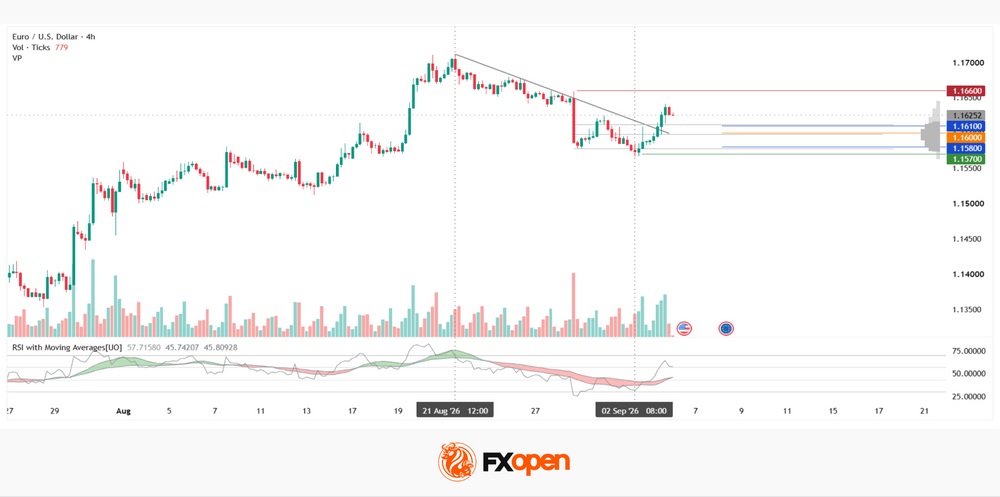
EUR/USD Analysis: Downtrend Breakout Still Lacks Confirmation

euros.png


Today, 4 September, the market’s main focus is the August US employment report. According to CNBC, the consensus forecast calls for just 53,000 nonfarm jobs to be added following July’s decline, highlighting the continued weakness of the labour market. At the same time, the Federal Reserve’s focus is shifting towards inflation risks. In the eurozone, a Reuters poll showed that all 65 economists surveyed expect the ECB to raise its deposit rate by 25 basis points to 2.50% at its 10 September meeting, while around 91% expect the rate to remain at that level through the end of the year.
euros.jpg


TO VIEW THE FULL ANALYSIS, VISIT FXOPEN BLOG

Disclaimer: This article represents the opinion of the Companies operating under the FXOpen brand only (excluding FXOpen EU). It is not to be construed as an offer, solicitation, or recommendation with respect to products and services provided by the Companies operating under the FXOpen brand, nor is it to be considered financial advice.
 
AUD/NZD: Fresh Hikes on Both Sides, One Chart Still Undecided
dollars.png


The Aussie enters this week with genuine hawkish backing after Australia's Q2 GDP surprised sharply to the upside, pushing the market-implied probability of a September RBA hike from 48% to 57%, with a November move now more than fully priced. Governor Bullock's board has already flagged upside inflation risks tied to Middle East-driven energy costs, and rising Australian bond yields, which touched their highest level since April 2011 this week, are only reinforcing that hawkish backdrop.

Across the Tasman, the RBNZ delivered exactly what all five major New Zealand bank economists expected on Wednesday: a 25bp hike to 2.75%, the second consecutive increase after July's tightening move. Headline inflation remains elevated at 4.1%, though the central bank's own projections signal a likely pause in October before potentially resuming in December, leaving markets pricing roughly a 30% chance of another hike this year.

The result: two central banks now both firmly in tightening mode, though the RBA's path still carries more near-term uncertainty than the RBNZ's, whose next move already looks broadly telegraphed through year-end.

dollars.jpg


TO VIEW THE FULL ANALYSIS, VISIT FXOPEN BLOG

Disclaimer: This article represents the opinion of the Companies operating under the FXOpen brand only (excluding FXOpen EU). It is not to be construed as an offer, solicitation, or recommendation with respect to products and services provided by the Companies operating under the FXOpen brand, nor is it to be considered financial advice.
 
Weekly Market Insights with Gary Thomson: ECB Interest Rate, US Inflation, and UK GDP
news.png


Three key economic events could shape market sentiment in the second week of September: the ECB interest rate decision, the latest UK GDP data and US inflation figures.

In this video, Gary Thomson looks at what these releases could mean for monetary policy expectations and major currency, gold and equity markets.

Key topics covered:

ECB Interest Rate Decision
— 10 September — Markets are pricing in a 25-basis-point rate hike after Eurozone inflation accelerated to 3.3%. With the move largely expected, the ECB’s guidance on future policy could be more important for the euro.

UK GDP — 11 September — The UK economy grew by 0.4% in Q2, while June GDP expanded by 0.3%. Could the latest data confirm the resilience of the UK economy or point to a loss of momentum?

US Inflation — 11 September — US annual inflation slowed to 3.4% in July, while core inflation eased to 2.5%. The latest figures could influence expectations for the Federal Reserve’s next policy move and trigger volatility across USD pairs, gold and equity indices.

With both the ECB and Federal Reserve facing important monetary policy decisions, traders will be watching closely for any signals that could change expectations for future interest rates.

Watch it now and stay updated with FXOpen.

TO VIEW THE FULL ANALYSIS, VISIT FXOPEN BLOG

Disclaimer: This article represents the opinion of the Companies operating under the FXOpen brand only (excluding FXOpen EU). It is not to be construed as an offer, solicitation, or recommendation with respect to products and services provided by the Companies operating under the FXOpen brand, nor is it to be considered financial advice.
 
AUD/CAD Analysis: Atypical Volume Casts Doubt on Triangle Breakout
audusd.png


The key catalyst for the Australian dollar remains the July inflation data released on 26 August. The figure came in at 3.5% year-on-year, versus expectations of 3.2%, while the Trimmed Mean increased by 0.5% month-on-month, compared with a forecast of 0.3%. The following day, 27 August, NAB revised its forecast for the RBA’s next policy decision. The bank now expects a 25-basis-point rate hike at the September meeting, taking the rate to 4.6%, with the risk of another increase in November.

For the Canadian dollar, the key factor was the Bank of Canada’s decision. On 2 September, the central bank left its policy rate unchanged at 2.25% for the seventh consecutive meeting, highlighting economic uncertainty stemming from US tariffs and Canada’s retaliatory trade measures.

audusd.jpg


TO VIEW THE FULL ANALYSIS, VISIT FXOPEN BLOG

Disclaimer: This article represents the opinion of the Companies operating under the FXOpen brand only (excluding FXOpen EU). It is not to be construed as an offer, solicitation, or recommendation with respect to products and services provided by the Companies operating under the FXOpen brand, nor is it to be considered financial advice.
 
USD/JPY: BoJ Momentum Meets a Fed Still Undecided
yen.png


USD/JPY is caught in a genuine crossfire this week, and Thursday's move said it all: the yen surged nearly 2% in a single session, touching a one-month high near 155.28, as traders simultaneously priced in higher odds of a Bank of Japan hike and stayed alert to fresh intervention risk following July's joint US-Japan operation. BOJ board member Hajime Takata has even floated the possibility of outsized or back-to-back hikes to contain inflation, while Governor Ueda's comments this week reinforced expectations of a move as early as this month.

The dollar side offers no clean counter-narrative either. August's jobs report reshaped the Fed debate almost overnight, with payrolls coming in well above the 55,000 consensus, briefly reviving September hike bets that had cooled sharply after Fed Governor Waller signalled comfort with holding rates if inflation keeps easing. Markets are now split roughly 50–60% on a September move, leaving Chair Kevin Warsh's guidance, alongside the CPI and PPI prints later this week, as the real tie-breakers.

The result: a yen gaining genuine independent strength from hawkish BOJ signals, against a dollar whose own rate path remains stuck between conflicting data, leaving USD/JPY's next move hostage to whichever central bank commits first.

yen.jpg


TO VIEW THE FULL ANALYSIS, VISIT FXOPEN BLOG

Disclaimer: This article represents the opinion of the Companies operating under the FXOpen brand only (excluding FXOpen EU). It is not to be construed as an offer, solicitation, or recommendation with respect to products and services provided by the Companies operating under the FXOpen brand, nor is it to be considered financial advice.
 
Analytical UK Interest Rate Forecasts 2026–2029
gbp-1.png


The Bank of England held Bank Rate at 3.75% in July 2026, its fifth consecutive hold, while three of nine committee members voted for an increase. Before the Middle East conflict pushed energy prices higher in early 2026, most institutions expected further cuts this year. Now the debate is between a long hold and a rise.

This article covers institutional estimates for 2026 and for 2027 to 2030, the calendar events that could affect them, and what the UK interest rate forecast for next 5 years means for markets. Learn UK interest rate forecasts for next 10 years.

TO VIEW THE FULL ANALYSIS, VISIT FXOPEN BLOG

Disclaimer: This article represents the opinion of the Companies operating under the FXOpen brand only (excluding FXOpen EU). It is not to be construed as an offer, solicitation, or recommendation with respect to products and services provided by the Companies operating under the FXOpen brand, nor is it to be considered financial advice.
 
EUR/AUD: A Quiet RSI Signal Challenges the Downtrend
1.jpg


The euro enters this week's ECB meeting (September 9–10) with genuine hawkish backing, having already been told by insiders that policymakers are prepared to raise rates again to counter the inflationary side-effects of the Middle East conflict, even as they signal little appetite for tightening beyond that. July's hold at 2.25% came with Lagarde explicitly warning that renewed hostilities and the resulting oil price rebound pose upside risks to the inflation outlook, keeping the door firmly open to a move back to 2.50% this week.

The Aussie, meanwhile, is riding one of its strongest stretches in months, hitting a fresh three-month high after Q2 GDP beat expectations at 0.4% quarter-on-quarter, reinforcing bets that the RBA could resume tightening this month. Markets now price a 50–58% chance of a September hike, with a November move seen as effectively locked in, while commodity strength and Australia's growing role in the AI infrastructure boom add further structural support to the currency.

The result: two hawkish central banks converging on rate decisions within days of each other, leaving EUR/AUD's next move to hinge on whether Frankfurt or Canberra delivers the more convincing signal.

1.png


TO VIEW THE FULL ANALYSIS, VISIT FXOPEN BLOG

Disclaimer: This article represents the opinion of the Companies operating under the FXOpen brand only (excluding FXOpen EU). It is not to be construed as an offer, solicitation, or recommendation with respect to products and services provided by the Companies operating under the FXOpen brand, nor is it to be considered financial advice.
 
Back
Top Bottom