
• forum.forex will be closed down on 31st October 2026.

    Contact Us for Acquisition enquiry

HFMarkets (hfm.com): New market analysis services.

Date: 12th November 2026.

Anthropic's IPO: Bigger Than It Looks, Backed by Its Own Suppliers.


Anthropic's IPO: Bigger Than It Looks, Backed by Its Own Suppliers


Behind the record-sized headline sit two features investors should understand: a large pool of insider stock that can be sold from day one, and a $26bn cheque from the companies Anthropic pays for chips and computing power.

Anthropic plans to price its NASDAQ listing on 18 November, with shares expected to trade the next day under the ticker ANT. At the top of its 70–78 range, the IPO raises about $64bn, or roughly $74bn with the greenshoe. Add a $26bn private placement and the total passes $100bn, rivalling SpaceX’s record June listing.

Demand looks strong. The Financial Times reports that bankers expect to price above the range, lifting the valuation towards $1.5tn or more. But the headline numbers hide two things. The deal puts more stock on the market than the offering size suggests, and much of the money comes from Anthropic's own suppliers.
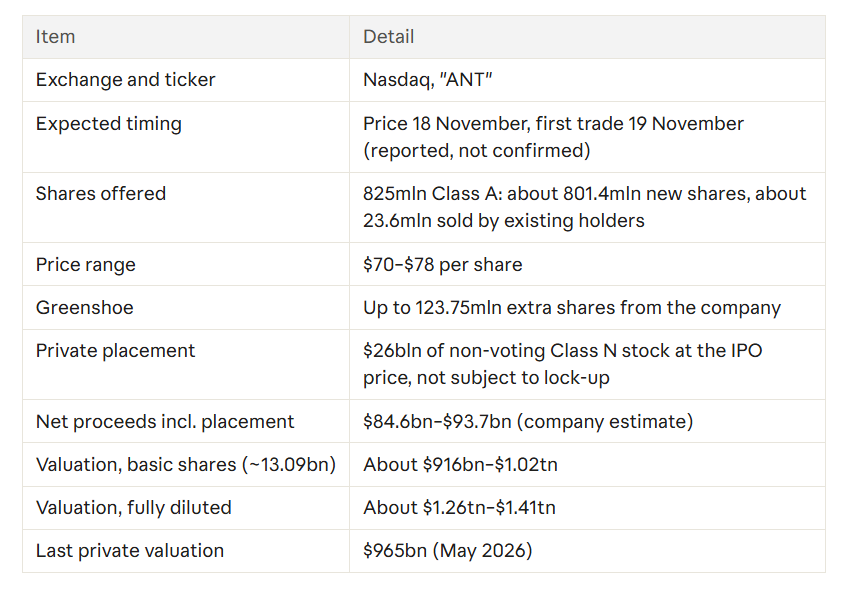
The deal at a glance​

As of Wednesday, the formal range is unchanged at 70–78; any increase would come in an amended filing before pricing.
2026-11-12 10_01_06-48132278 - HFMarketsGlobal-Demo - Netting - HF Markets (SV) Ltd. - [USDIndex,Wee


Bigger than it looks: the insider stock outside the deal

On paper, almost all the money goes to Anthropic. About 801.4mln of the 825mln shares are new. Existing holders sell only about 23.6mln, under 3% of the offering and worth up to roughly $1.8bn.

Most of that comes from the founders. The Wall Street Journal reports that Dario Amodei, Daniela Amodei, and five other co-founders each plan to sell about $250mln worth of shares. Each would keep a stake worth around $18bn.

The bigger number sits elsewhere in the filing. Non-founder insiders, such as employees and early investors, can sell up to 10% of their holdings on the first day of trading, without a lock-up. FT Alphaville's Craig Coben estimates that could mean as many as 316 mln shares, worth almost $25bn at the top of the range.

That is potentially about 15 times the advertised secondary sale. It would lift total supply from 825 mln shares to around 1.14bn, roughly 38% more than the offering size suggests. The $26bn placement shares are not under underwriter lock-ups either.

None of this is hidden; it is all disclosed, and nobody knows how much insiders will actually sell. What matters is where the selling happens. Shares in the bookbuild are priced and placed by the banks. Shares sold on day one go straight to the open market, at whatever price is available.

Dilution is the second hidden number. About 13bn shares will be outstanding after the deal. Counting options, restricted stock units, and shares reserved for a charitable donation-matching programme lifts that to around 18bn. That is why the same share price produces headline valuations of about $1tn and about $1.4tn.

Backed by its own suppliers: the $26bn placement​

Seven companies are buying $26bn of stock at the IPO price: AMD, Broadcom, Google, Micron, Microsoft, Nvidia and TSMC. Between them they supply most of what an AI lab spends money on: chips, memory, foundry capacity and cloud computing.

That matters because Anthropic’s revised filing shows about $895bn of purchase commitments for compute and infrastructure. In plain terms, Anthropic’s suppliers are investing in Anthropic, and Anthropic’ will spend heavily with them.

There are two ways to read this. The generous reading is a vote of confidence from the firms that know the AI supply chain best. The sceptical reading is that it adds to the ‘circular financing’ pattern critics see across the sector, where money flows from suppliers to customers and back again. As Coben notes, a stumble by Anthropic would weigh on the valuations of these same suppliers, so the placement is partly self-interest.

Can Revenue Keep Up With the Commitments?​

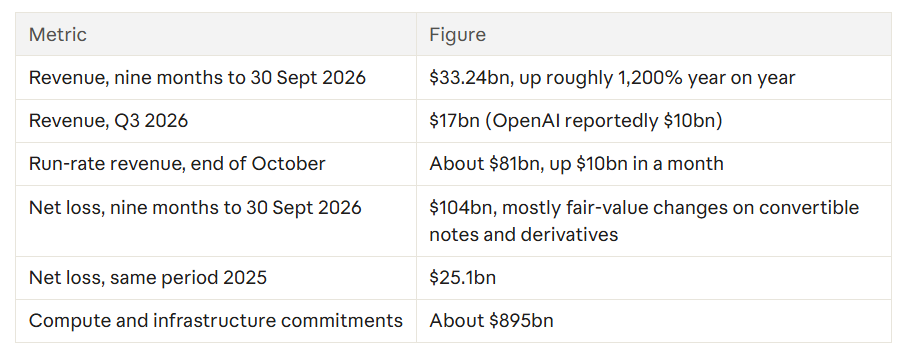
The circularity question comes down to whether Anthropic can grow into its spending. The filing shows rapid growth set against even larger commitments.

Two of these figures matter most, and both are easy to misread. First, run-rate is an annualised snapshot of recent sales, not revenue already booked. Second, the headline loss is inflated by accounting for convertible instruments, so it says more about the capital structure than about day-to-day operations.
2026-11-12 10_02_48-48132278 - HFMarketsGlobal-Demo - Netting - HF Markets (SV) Ltd. - [USDIndex,Wee

On valuation, $1.41tn is about 17 times run-rate revenue; $1.5tn would be about 18.5 times. Morningstar puts fair equity value at $1.7tn but says a plausible range runs from $500bn to $3tn, depending on how fast businesses adopt AI tools. That spread is the honest summary: the outcome hinges on growth that has not happened yet, set against spending commitments that are already signed.

What to watch​

  • The final price. A raised range would need an amended filing before pricing, expected on 18 November. Pricing above $78 would confirm that demand has outrun last week’s caution.
  • Day-one supply. How much insider stock hits the market on the first day may matter more for early trading than the IPO price itself.
  • Retail exposure. A target of about 20% for retail investors is double or more the usual share. More individual investors will own the stock from the start, at a price set during a period of intense excitement.
  • The wider AI trade. The listing follows a $3.2tn tech sell-off after the midterm elections, rising rate worries, and SoftBank’s revised US data-centre plans. Delays elsewhere in the AI build-out could weigh on sentiment towards Anthropic and its supplier-investors alike.
The bottom line: demand for the deal looks strong, and the companies involved have every reason to want it to succeed. Whether early buyers are rewarded is a separate question, and the after-market, not the bookbuild, will answer it.

Always trade with strict risk management. Your capital is the single most important aspect of your trading business.

Please note that times displayed based on local time zone and are from time of writing this report.


Click HERE to access the full HFM Economic calendar.

Want to learn to trade and analyse the markets? Join our webinars and get analysis and trading ideas combined with better understanding of how markets work. Click HERE to register for FREE!

Click HERE to READ more Market news.

Andria Pichidi
HFMarkets

Disclaimer:
This material is provided as a general marketing communication for information purposes only and does not constitute an independent investment research. Nothing in this communication contains, or should be considered as containing, an investment advice or an investment recommendation or a solicitation for the purpose of buying or selling of any financial instrument. All information provided is gathered from reputable sources and any information containing an indication of past performance is not a guarantee or reliable indicator of future performance. Users acknowledge that any investment in Leveraged Products is characterized by a certain degree of uncertainty and that any investment of this nature involves a high level of risk for which the users are solely responsible and liable. We assume no liability for any loss arising from any investment made based on the information provided in this communication. This communication must not be reproduced or further distributed without our prior written permission.
 
Date: 13th November 2026.

Nvidia Stock Outlook: Risks After Jensen Huang's Exit.


Nvidia Stock Outlook: Risks After Jensen Huang's Exit

The Nvidia stock outlook has become increasingly uncertain following the resignation of Jensen Huang, the company's co-founder and chief executive for more than three decades.

His departure comes at a difficult moment for the semiconductor giant. Investors were already questioning the sustainability of extraordinary spending on artificial intelligence infrastructure and the valuations attached to the companies benefiting from it.

Now Nvidia faces a leadership transition alongside a sharp stock market correction. Shares have fallen more than 30% from their October record, while the company has lost its position as the world's most valuable publicly traded business.

The central question for investors is whether Nvidia can preserve its competitive advantage in artificial intelligence without the executive who helped establish it as an industry leader.

Nvidia's recent sell-off highlights how quickly investor expectations can change, even for a company reporting exceptional revenue growth.

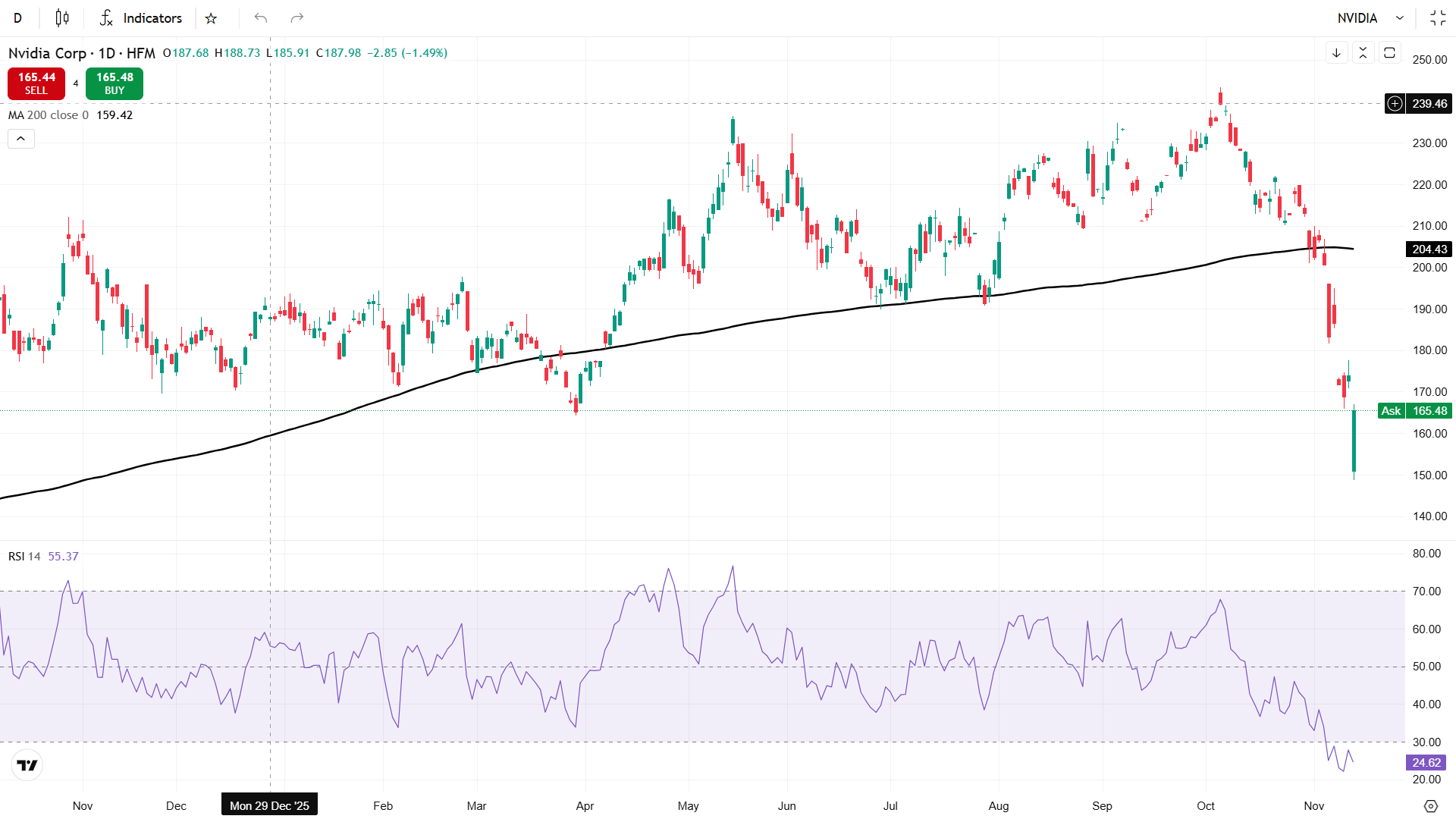
On 6 October 2026, Nvidia shares reached an all-time intraday high of $243.37. By the close of trading on 12 November, the stock had fallen to $166.19, representing a decline of approximately 31.7% from that peak.

Thursday's trading session was particularly volatile.

The share price briefly touched $148.80, approximately 14.3% below the previous closing price. However, Nvidia recovered a significant portion of those losses and ended the session down 4.34%.

The intraday recovery suggests investors were far from unanimous about how to value the company after Huang's departure. Nevertheless, a rebound within a single trading session does not necessarily indicate that the broader correction has ended.

The key distinction is between falling share prices and deteriorating business fundamentals.

Nvidia's market value can decline because investors become less willing to pay a premium for its future earnings, even if the underlying business continues to expand.

That distinction is particularly important when assessing the company's outlook.

Nvidia_12_11_2026


Another significant development has been Nvidia's loss of its position at the top of the global market-capitalisation rankings.

On 3 November, Nvidia had been the world's most valuable listed company, with a market value of approximately $4.99 trillion.

The subsequent decline changed that ranking.

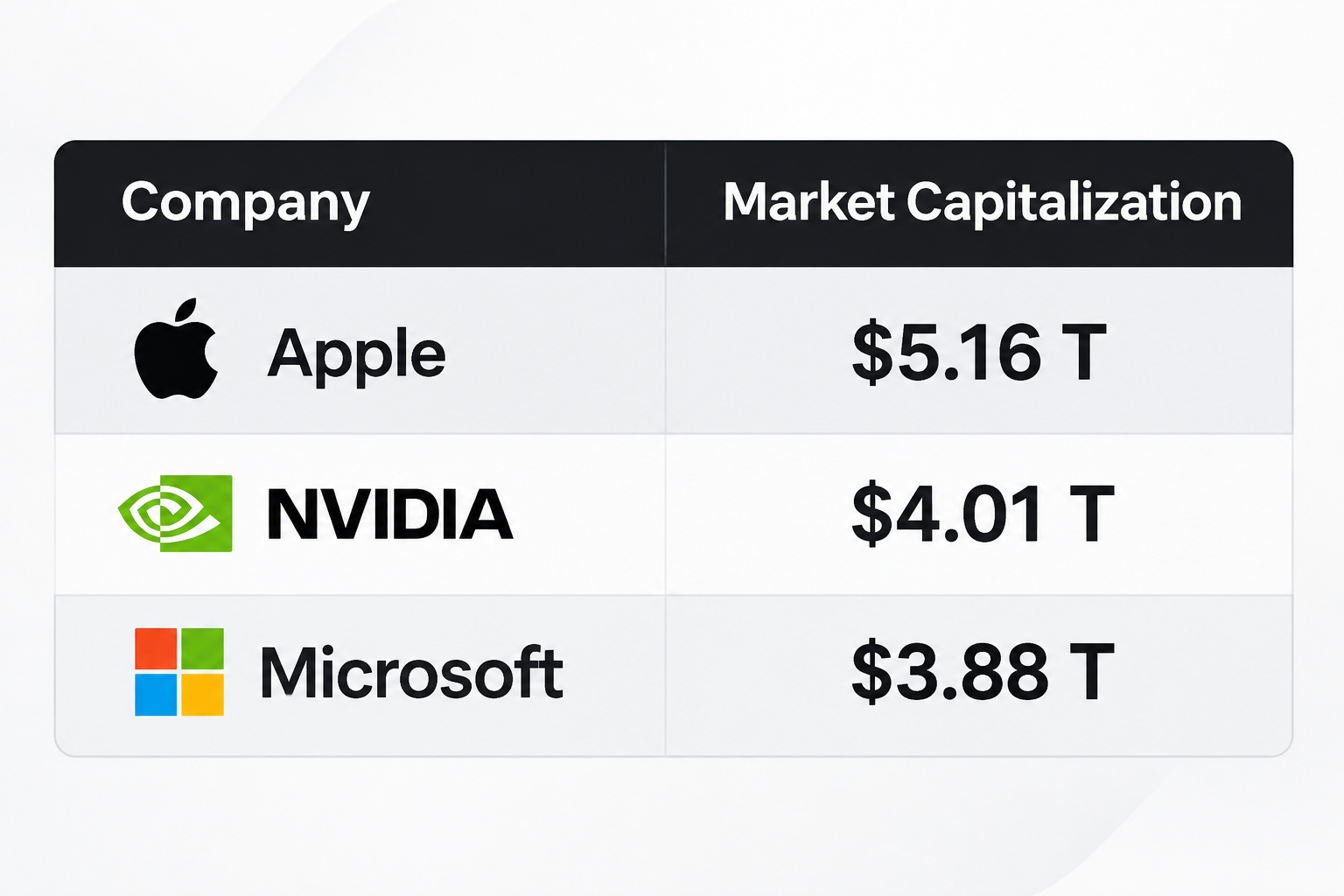
At the US market close on 12 November 2026, the approximate market capitalisations of the three technology giants were:

Market Capitalisation of Leading Tech Companies


Nvidia therefore ranked second behind Apple, remaining ahead of Microsoft.

Earlier in the day, pre-market projections had suggested Nvidia might fall into third place. However, those estimates did not reflect its eventual closing position.

The change illustrates the scale of the repricing taking place across the technology sector.

More importantly, it raises a fundamental question: is Wall Street responding to a temporary leadership shock, or reassessing the assumptions behind Nvidia's long-term valuation?

Jensen Huang's departure carries unusual significance because his influence extended well beyond the responsibilities of a conventional chief executive.

Since co-founding Nvidia in 1993, Huang helped transform the company from a graphics processor manufacturer into one of the most important providers of computing infrastructure for artificial intelligence.

The company's competitive position rests on more than its graphics processing units.

Nvidia has developed an integrated ecosystem combining advanced processors, high-speed networking, systems software and its CUDA programming platform.

This infrastructure supports the training and deployment of sophisticated AI models used by cloud computing providers, technology companies, research institutions and emerging AI businesses.

Huang also played a central role in Nvidia's relationships with major customers, technology partners and governments.

His departure therefore introduces questions about strategic continuity, customer confidence and the company's ability to maintain its rapid pace of innovation.

However, Nvidia's technological capabilities do not disappear with its founder.

Its engineering teams, intellectual property, software ecosystem and commercial relationships remain embedded within the organisation.

For investors, the real issue is whether the new leadership can preserve the execution standards and strategic direction that helped Nvidia achieve its dominant position.

Nvidia confirmed on 12 November that Huang had resigned as president, chief executive officer and a member of its board of directors, following several days of controversy and questions surrounding corporate governance.

On 8 November, Huang publicly acknowledged having been unfaithful to his wife, without identifying the other person involved.

Reuters subsequently reported, citing people familiar with the matter, allegations involving additional personal relationships, including two with Nvidia employees.

Separate reporting also raised suspicions about possible links between a businesswoman associated with the controversy and Chinese intelligence. Those allegations have not been publicly established as proven facts.

Nvidia's board announced an independent investigation into reports that Huang may have been targeted by a foreign intelligence operation.

The company stated that it had no reason to believe its trade secrets or US national security had been compromised.

The investigation was subsequently placed under external legal supervision.

From an investment perspective, the principal issues concern corporate oversight, potential regulatory consequences and the effectiveness of internal governance controls.

These questions are more relevant to Nvidia's valuation than the personal details of the controversy.

Following Huang's resignation, Nvidia appointed Colette Kress as interim chief executive officer.

Kress will also continue serving as the company's chief financial officer, a position she has held since joining Nvidia in September 2013.

Before Nvidia, she held senior finance roles at Microsoft and Cisco, giving her extensive experience in large technology businesses.

Her appointment provides a degree of operational and financial continuity during a period of considerable uncertainty.

The board also appointed Harvey C. Jones as its first chair and launched a search for a permanent CEO, considering both internal and external candidates.

Kress's immediate priorities are likely to include maintaining customer relationships, preserving the existing product roadmap and ensuring that the company's substantial financial commitments remain aligned with its strategy.

Investors will also be watching how the permanent succession process develops.

A swift, orderly transition could help restore confidence. Conversely, prolonged uncertainty over leadership may continue to affect Nvidia's market valuation.

Despite the sharp decline in its share price, Nvidia's most recent published earnings continued to demonstrate substantial business growth.

For the second quarter of fiscal 2027, reported on 26 August 2026, the company generated $96.22 billion in revenue, representing year-on-year growth of 106%.

Data centre revenue reached approximately $89 billion, up 117% from the previous year, while the GAAP gross margin stood at 75%.

For the third quarter, Nvidia had projected revenue of approximately $108 billion, plus or minus 2%.

These figures demonstrate the scale of demand for Nvidia's AI computing infrastructure before the latest leadership crisis.

However, strong historical performance does not guarantee future growth.

Investors remain concerned about whether hyperscale cloud providers can sustain their extraordinary capital expenditure, whether export restrictions could further constrain Nvidia's access to China, and whether increasing competition might eventually put pressure on margins.

The central challenge is therefore not simply maintaining revenue growth, but delivering results strong enough to justify the market's expectations.

The reaction among Wall Street analysts has been mixed, reflecting the difference between confidence in Nvidia's technology and concern about its leadership.

Goldman Sachs maintained a favourable assessment of Nvidia following Huang's departure. Analyst James Schneider acknowledged the significance of the event but suggested that the direct impact on financial performance over the next 12 to 18 months could remain limited.

That view reflects the company's existing order commitments and established product development roadmap.

Bernstein, however, downgraded Nvidia to Market-Perform and reduced its price target to $200. Analyst Stacy Rasgon highlighted the uncertainty created by the leadership transition despite the continued strength of the underlying business.

Oppenheimer also downgraded the stock and withdrew its price target. Analyst Rick Schafer raised concerns about succession risks and the potential loss of key personnel.

Meanwhile, RBC Capital Markets lowered its price target from $330 to $230 while maintaining an Outperform rating, suggesting that near-term fundamentals could remain resilient despite the growing uncertainty.

These assessments represent the published views of financial analysts. They do not establish that institutional investors as a group are buying or selling Nvidia shares.

Three principal concerns emerge from the research.

Execution risk. Huang's direct involvement in product strategy, customer relationships and long-term planning raises questions about how efficiently Nvidia can operate without his leadership.

AI ecosystem financing. Nvidia's influence extends beyond chip sales. Its investments and financing arrangements with infrastructure providers and AI companies have helped support the industry's expansion. Changes to those relationships could affect demand expectations across the sector.

Valuation risk. Even if Nvidia continues delivering strong revenue growth, investors may assign a lower earnings multiple to the company if uncertainty about its future increases.

This means Nvidia could continue expanding its operations while its share price remains under pressure.

The leadership transition may also influence purchasing decisions across the AI semiconductor market.

Companies such as AMD, Broadcom and Marvell compete in different areas of computing, networking and data centre infrastructure.

If major customers seek to reduce their dependence on Nvidia, some competitors could potentially benefit from increased interest in alternative solutions.

The market reaction on 12 November offered an early indication of that possibility, with AMD and Broadcom shares advancing while Nvidia declined.

Nevertheless, replacing Nvidia's technology is not straightforward.

Its CUDA software ecosystem, integrated hardware platforms and established customer relationships create significant competitive barriers.

Any meaningful shift in market share would depend on product performance, supply availability, software compatibility and total operating costs.

Therefore, a leadership change alone does not establish that Nvidia's competitors will capture a substantial share of its business.

Huang's resignation has also prompted speculation about his next professional move.

Elon Musk publicly responded to a suggestion that he should hire the former Nvidia CEO by saying it would be an honour.

The remark attracted attention because Nvidia's computing technology plays an important role in the AI initiatives of companies associated with Musk.

The two executives also have longstanding business connections.

However, there has been no confirmed formal job offer, announced position or publicly verified recruitment agreement.

Musk's statement should therefore be interpreted as an expression of interest rather than evidence of an imminent appointment.

Any future move involving Huang could become relevant to the wider AI industry, but its potential competitive implications remain speculative.

Nvidia's future share price performance will depend on how successfully the company manages its leadership transition and whether its financial results continue supporting current growth expectations.

An orderly succession process, resilient earnings and clear evidence of technological continuity could help improve investor sentiment.

Under this scenario, markets may gradually shift their attention back towards data centre demand, margins and the company's ability to sustain its competitive position.

A recovery in confidence would not necessarily mean an immediate return to previous share price highs.

If the search for a permanent CEO takes longer than expected or investors become concerned about changes in strategic direction, volatility could remain elevated.

Nvidia could continue reporting strong operating results while facing pressure on its valuation multiples.

This scenario would underline the difference between business performance and investor confidence.

Further regulatory complications, tighter trade restrictions or a slowdown in AI infrastructure investment could create a more challenging outlook.

Such developments might affect both projected earnings and the valuation investors are willing to assign to Nvidia.

This would represent a more fundamental concern than the leadership transition alone.

These scenarios are not forecasts with guaranteed outcomes. Their relevance will depend on new financial information, corporate decisions and broader market conditions.

Nvidia is scheduled to report its third-quarter fiscal 2027 results on Tuesday, 17 November 2026.

The earnings announcement will give investors an opportunity to assess the company's operational performance against the uncertainty surrounding its leadership.

Particular attention is likely to focus on data centre revenue, gross margins, demand from major cloud providers, progress on the Vera Rubin platform and updated financial guidance.

One important benchmark will be Nvidia's previous quarterly revenue outlook of $108 billion, plus or minus 2%.

Investors will also be looking for reassurance about the continuity of the company's strategy, its commercial relationships and the process for appointing a permanent CEO.

For traders monitoring NVDA, the Nasdaq and other AI-related equities, the announcement could produce substantial price movements.

Market volatility may increase around major earnings releases, while leverage can amplify potential losses as well as gains.

Jensen Huang's departure marks an important turning point for Nvidia, coming after a stock market correction of more than 30% from its all-time high.

The loss of its position as the world's most valuable listed company illustrates the extent of the change in investor sentiment, but it does not automatically mean Nvidia has lost its technological leadership.

The company retains an influential position in global AI infrastructure.

Its challenge is to demonstrate that this competitive strength can endure under new leadership, alongside growing competition, regulatory scrutiny and increasingly demanding financial expectations.

Ultimately, Nvidia's stock outlook will depend less on speculation about Huang's personal future and more on whether the company can translate its technological advantages into sustainable financial performance.

The next earnings announcement, developments in the board investigation and the appointment of a permanent CEO will be central to assessing the risks and opportunities ahead.

Always trade with strict risk management. Your capital is the single most important aspect of your trading business.

Please note that times displayed based on local time zone and are from time of writing this report.


Click HERE to access the full HFM Economic calendar.

Want to learn to trade and analyse the markets? Join our webinars and get analysis and trading ideas combined with better understanding of how markets work. Click HERE to register for FREE!

Click HERE to READ more Market news.

Jarek Duque
HFMarkets

Disclaimer:
This material is provided as a general marketing communication for information purposes only and does not constitute an independent investment research. Nothing in this communication contains, or should be considered as containing, an investment advice or an investment recommendation or a solicitation for the purpose of buying or selling of any financial instrument. All information provided is gathered from reputable sources and any information containing an indication of past performance is not a guarantee or reliable indicator of future performance. Users acknowledge that any investment in Leveraged Products is characterized by a certain degree of uncertainty and that any investment of this nature involves a high level of risk for which the users are solely responsible and liable. We assume no liability for any loss arising from any investment made based on the information provided in this communication. This communication must not be reproduced or further distributed without our prior written permission.
 
Back
Top Bottom